
Nature’s MDMA

I’ve written a bit about my experiences with plant medicine. I have taken high doses of psilocybin and while I don’t think it is the miracle cure for everything that the psychedelic podcasts and books would have you believe, I do think my use of magic mushrooms has helped my mental health. From my 40s onward I tried most of the SSRIs that exist and have used other medications off label to mitigate my moods. My psychological challenges are somewhat atypical; I don’t fall conveniently into the categories described in the DSM-5. My lows have never fit the usual label of depression. The best way I can illustrate my mind states is to think of them as the month of March in the northeast US, which also happens to be my birth month. You could get everything from a sunny, balmy day to a tornado. Or just heavy gray skies. These moods have interfered with my activities. Over the past 7.5 years I have managed to get off all pharmaceutical medicines commonly prescribed for mental health problems. I do microdose with psilocybin and I have started experimenting with new plant medicines, including kanna, which is what I want to talk about here.
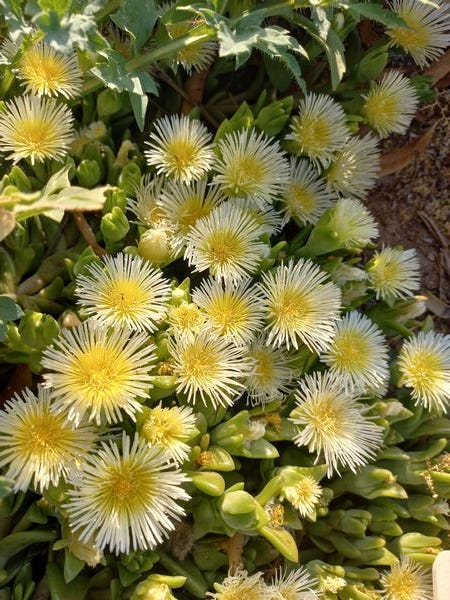
Kanna, Mesembryanthemum tortuosum, is a succulent that grows in the Cape Provinces of South Africa. It was chewed by the indigenous Khoisan people and contains more than 25 alkaloids. Its effects are described as euphoric, but I would say that these effects are quite subtle. And unlike with many plant medicines, the body seems to adapt over time to the point where one becomes more rather than less attuned to the sensations generated by continued use. I agree with this based on my own experience.
I started using kanna a couple of months ago. I tried sublingual lozenges and capsules as well as a powder that can be insufflated. At first I felt nothing. But having read that it takes repeated attempts to feel much, I kept trying. Now I definitely sense something. I would describe this feeling as cheerful or optimistic (hey, we could all use more of that!) with a soupçon of connection with others. It’s the psychological equivalent of sharing a funny meme with a friend on a fine spring day. Kanna is a bit like a blossom opening to receive the sun. People say that they like to take it before social situations. I did feel that it made me more open to group workshopping during my recent memoir-writing retreat. But some of that was probably canceled out by the heaviness of the trauma discussed.
I haven’t noticed any comedown or physical discomfort associated with my feeling afterward. Once in a while I feel a vague nausea at first, which is mitigated by a little bit of food in the stomach. Combining kanna with caffeine might make you a bit jittery. Of course all this is highly subjective—you’ll have to see for yourself in you’re interested in trying it. It is legal at present but I would research potential sources carefully to make sure it’s sourced sustainably and tested for contaminants. Don’t buy stuff in gas stations!
If you do a search for podcasts on Kanna you will come up with a few. I prefer the more scientific podcasts to those that project human qualities onto plant medicines and wax all lyrical about them. If you’re looking for information, the woo-woo attitude can be a bit of a turn-off. For me, anyway. Sometimes the hosts know absolutely nothing and haven’t bothered to do any research beforehand. That is annoying. Look into Kanna if it intrigues you. Just beware of grift. In the wellness community there is a lot of that. In fact, grift seems to be everywhere. No wonder we’re all looking for a boost in mood.
Had not heard of this plant before