Sage Advice

Salvias may be my favorite genus of plants. It’s a large group with just under 1000 species of annuals, perennials, and shrubs. Salvias are part of the mint tribe; many people recognize the square stems. These plants are distributed over the New and Old world and some of them are culinary (the sage you find in the spice aisle as well as rosemary, recently reclassified as a salvia) while others are not as edible—in fact, salvia divinorum, which I will discuss in a bit, causes hallucinations. Some have very showy flowers and great value in the garden while others have small, innocuous blooms.
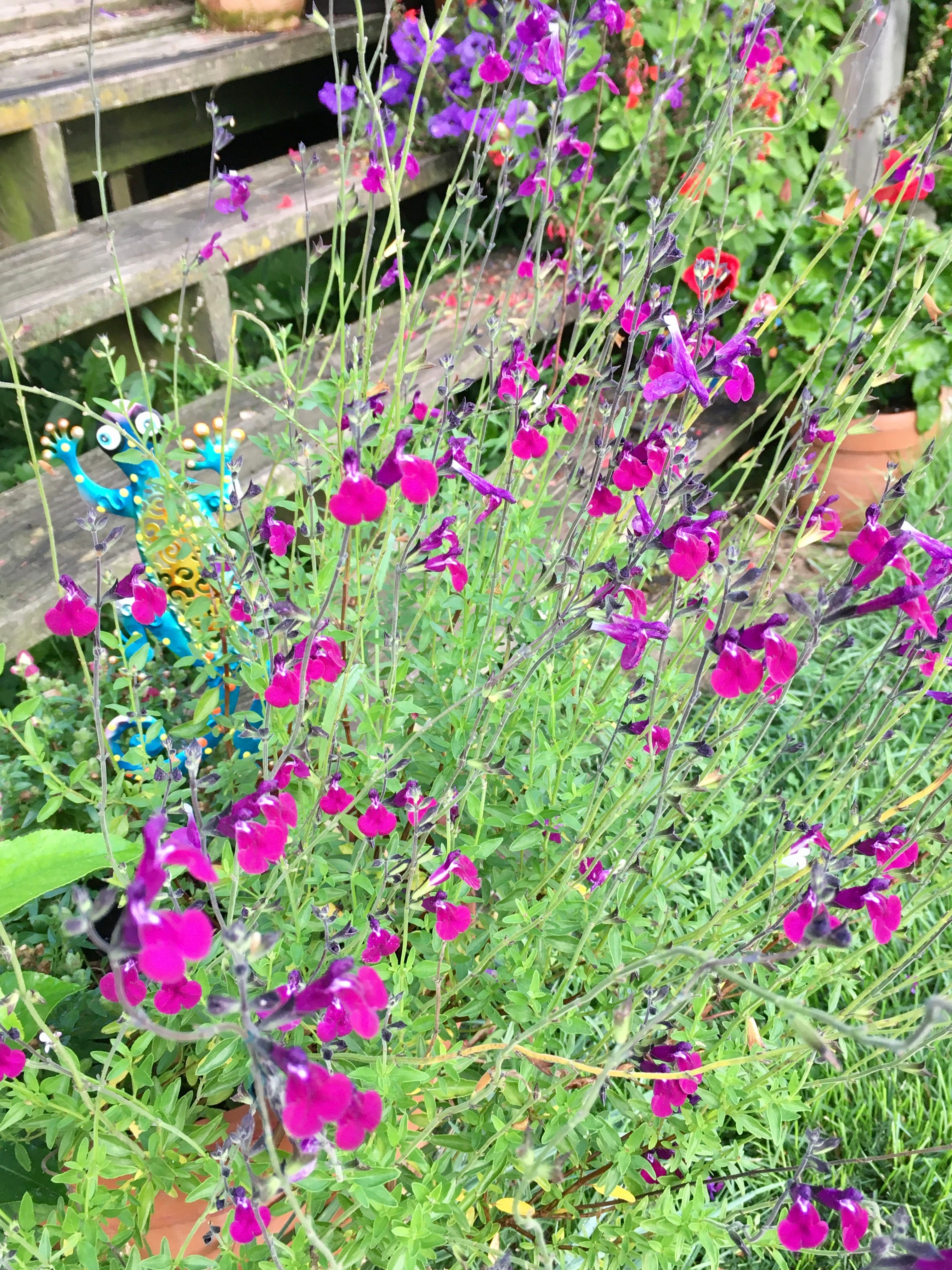
I grow many salvias in my garden—as many as I can get my hands on—both in beds and in pots. The tender ones are in pots on my porch but I also grow some in my flower beds as annuals. The plant known as meadow sage (salvia pratensis or s. nemorosa) is a very popular and reliable perennial in my zone 5 landscape. Its flowers can be white to shades of lavender, purple, and even hot pink. I have noticed that the hot pink variety does not usually survive our winters—my guess is that as a more recently developed cultivar it is perhaps less hardy.
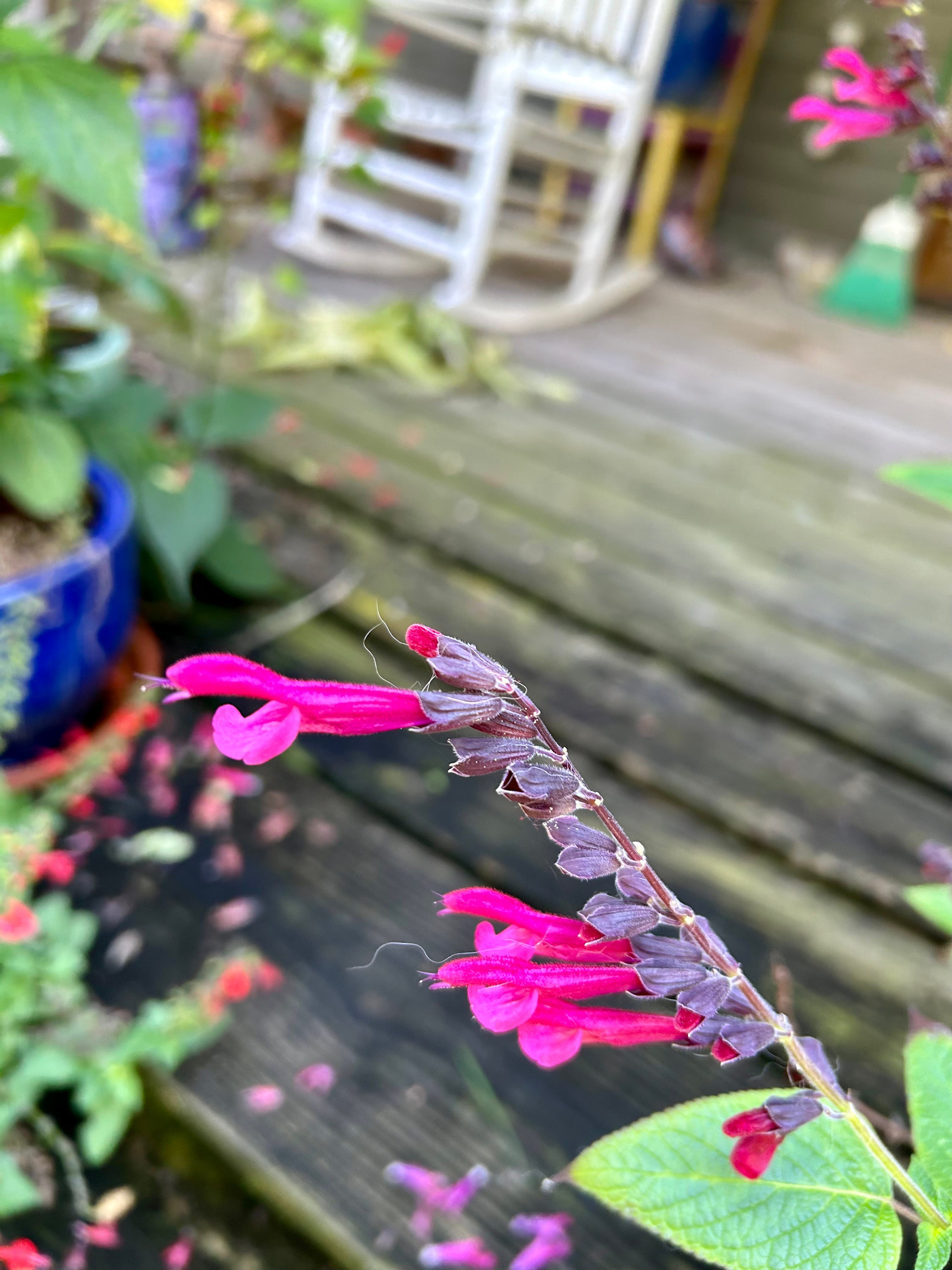
You may recognize the salvias used in the landscaping approach my husband and I call “Amish Bank.” This unfortunate style combines the meticulousness of the usual Amish garden (easily achieved when you have 7 children to edge and weed-whack) with all the imaginative design of a drive-thru bank. These salvias are dwarf with bright red flowers that continue until frost. The plants do as they’re told and nary a stem dares to extend past the border of bark mulch. I avoid them completely, viewing them with contempt, but I do grow their ancestor salvia splendens species that I obtain from Select Seeds Antique Flowers. These salvias are rambling and tall, reaching up to attract hummingbirds that fight over access like little ninjas. I keep these in pots on my porch. Bolivian Sage is another interesting salvia that has fuzzy stems and flowers in cerise. It takes a really long time to get going in my climate, however. There are many blues in the salvia family as well, from deep indigo salvia guarantica to cerulean bog sage (salvia uliginosa).
As I mentioned above, a notable species is salvia divinorum. It is a shrubby plant found only in the Sierra Mazateca in the state of Oaxaca, Mexico. Its leaves are chewed by the Mazatecs to induce visions; they call it Maria Pastora. It can also be smoked. Salvia divinorum is unique in several ways. Most plants that cause states of altered consciousness contain alkaloids—examples are nicotine, caffeine, and morphine. The active compound in salvia divinorum, salvinorin A, is not an alkaloid and is the most potent psychoactive substance discovered thus far. Most of the well-known psychoactive plants and fungi, such as psilocybin mushrooms and the preparation ayahausca or yagé, act on the serotonin receptors; salvinorin A is a kappa-opioid agonist. This suggests that the plant may be useful in addressing opioid addiction because it stops withdrawal symptoms immediately. It is very potent and around 2007 caused a panic after YouTubes posted by users showed dramatic reactions to smoking salvia. However, the dosage taken by these users was extremely high. Used in much lower doses the plant causes comparatively subtle responses that last only a few minutes. As always, uninformed reactions by government agencies have affected the legal status of salvia divinorum. While it is not federally banned, some states have made the sale illegal. One would think the government would have more important issues to address, but of course not.
Salvias are pollinator magnets. I love to watch the moths, butterflies, and hummingbirds visit them in my garden, as well as bees. They tend to bloom all season as well in a varied palette from pinks to purples to blues as well as shades of red and burgundy. I love to come upon them growing wild during my trips to Mexico. I encourage you to seek out different varieties of salvia in your landscape. Way more interesting and beneficial than grass!